Photography Website Design: What to Include in 2026
What good photography website design looks like in 2026: the pages, fast galleries, client proofing, image SEO, copyright and where to build it.

Good photography website design puts your strongest 20 to 40 images in front of the right client, loads them fast on a phone, and makes booking you one obvious step. That means a tight portfolio split by the kind of work you sell, a clear services or pricing page, and a contact form that asks the questions you need answered.
This guide covers the pages a photographer's site needs, how to keep large galleries fast, where client proofing fits, image SEO, protecting your work, and which builder to use. If you also show illustration or fine art, our art portfolio website guide covers that side.
The Pages a Photography Website Needs
Most photographers need six pages: a home page that shows your best work at once, a portfolio split by genre, an about page with a photo of you, a services or pricing page, a contact or booking page, and client galleries kept separate from the public portfolio. A blog is optional.
Page | Its job | What to put on it |
|---|---|---|
Home | Show your style in one screen | Your name, what you shoot and where, one strong image or a short reel, and a button to the portfolio or booking |
Portfolio | Prove you can do the job | Galleries split by genre (weddings, portraits, products), 15 to 40 images each, best first |
About | Make you someone to hire | A recent photo of you, how you work, the area you cover, and anything a client asks before booking |
Services or pricing | Qualify enquiries | What each package includes, how many images and how they are delivered; a "from" price if you are comfortable sharing one |
Contact or booking | Turn interest into a booking | A short form with date, location, type of shoot and budget, plus your email address |
Client galleries | Deliver and proof work | Private, password-protected galleries, usually on a proofing platform linked from the menu |
Keep the public portfolio for the work you want more of. If you shoot weddings and products but want more weddings, lead with weddings and move products lower or onto their own page.
Design the Portfolio Around the Work You Sell
A photography portfolio works when a client can see, within a few seconds, that you shoot what they need. Split galleries by the type of client, not by date, and edit each one hard: twenty great images beat a hundred good ones.
- One gallery per service. A couple planning a wedding should not have to scroll past headshots to find wedding work.
- Lead with the strongest image. The first frame of each gallery is the one most people judge you by.
- Show complete stories. For events and weddings, one full sequence from a single day shows consistency better than scattered highlights.
- Let the images breathe. Plain backgrounds and generous spacing keep attention on the photos, not on the interface.
- Add a line of context. A title, location and client type under each gallery helps both visitors and search engines.
For layout ideas, our portfolio website examples show how live portfolios handle grids, full-screen images and project pages, and how to design a portfolio website walks through the structure step by step.
Keep Large Galleries Fast
Image-heavy pages are slow by default, so speed is a design decision on a photography site. Export images at the size they are shown, use a modern format, and let the browser pick the right file for each screen. A slow first image costs you visitors before they see your work.
Google's guidance on Largest Contentful Paint asks for the main content to appear within 2.5 seconds for at least 75 per cent of page loads, and on a photography home page that main content is usually your hero image. Background images count too, so a full-screen cover photo is measured the same way.
Do | Why it helps |
|---|---|
Export at display size (often 2,000–2,500 px on the long edge) | A 6,000 px file straight from the camera is several times heavier than the screen needs |
Use WebP or AVIF | Google Images supports both, so switching from JPEG costs you nothing in search |
Serve responsive sizes with srcset | Phones download a small file, large screens a large one |
Lazy-load images below the first screen | The browser only fetches what the visitor is about to see |
Do not lazy-load the hero image | It is the largest element on the page, so it should load first |
Keep video reels short and muted | A long autoplay video can outweigh every photo on the page |
On a visual builder, check what the platform does with uploads before you export; on a code template you handle sizes yourself, with the srcset attribute or a framework's image component.
Client Proofing and Delivery
Client proofing usually lives outside the portfolio site. A dedicated gallery platform handles private galleries, favourites, downloads and print sales better than a website builder, and you link to it from your menu as "Client login" or "Galleries".
Pixieset is one common choice: its Client Gallery has a free plan with 3 GB of storage and unlimited galleries, and paid plans start at $8 a month billed annually. The company also offers a separate Pixieset Website builder with a free tier that sits alongside the galleries.
Keeping the two apart has a practical benefit. Your portfolio can live on Framer, Webflow or a code template with the design you want, while the proofing tool handles passwords, storage and downloads. Clients only need one link, and your public site stays fast because it never holds full-resolution client files.
Image SEO for Photographers
Search engines cannot see a photograph, so they rely on the text around it. Write descriptive file names and alt text, put images next to related text, and give every gallery a short written introduction. These steps come straight from Google's image SEO guidance.
- File names: rename exports to something like santa-fe-wedding-first-dance.jpg instead of IMG_4821.jpg.
- Alt text: describe what is in the frame in plain words; Google warns against filling alt attributes with keywords.
- Text near images: a gallery with a title and two sentences about the shoot gives search engines context a bare grid lacks.
- Location pages: if you work in a specific area, name it on the about and services pages, in the words clients search for.
- Image sitemaps: submit one so search engines find gallery images they might otherwise miss.
On Framer, our Framer SEO guide shows where page titles, descriptions and alt text are set.
Protect Your Photos
No website setting stops a determined person from copying an image, because anything shown in a browser can be saved. What protects your work is registration, a clear licence in your terms, and sensible image sizes; right-click blockers mostly annoy real clients.
In the United States, the Copyright Office lets photographers register many images in one claim. According to Circular 42, a group can include up to 750 photographs by the same author with the same claimant, and a published group must all be published in the same calendar year. Fees change, so check the Office's fee schedule before you file.
- Publish at web size. A 2,000 px image is fine on screen but too small for a large print.
- Use a light watermark only where it fits. It can make sense on proofing galleries; on a portfolio it competes with the photo.
- State usage terms. Say on your services page what clients may do with the images they buy.
Where to Build a Photography Website
Choose on two things: how much design control you want and how much bandwidth your galleries will use. Framer and Webflow give the most layout freedom; Squarespace and Pixieset are more guided. Prices below were checked on each official pricing page on 6 October 2026.
Builder | Free option | First plan with a custom domain | Good for |
|---|---|---|---|
Free plan on a Framer domain, 1 GB bandwidth | Basic, $10/month billed yearly, 50 GB bandwidth; Pro is $30/month with 100 GB | Visual, image-led layouts and free templates | |
Starter site on webflow.io, 1 GB bandwidth | Basic, $15/month billed yearly, 10 GB bandwidth, no CMS; Premium is $25/month with CMS and from 50 GB | Precise layout control and CMS-driven galleries | |
14-day free trial | Basic, $12/month billed yearly ($19 monthly); annual plans include a free domain for the first year | A guided editor with hosting built in | |
Free tier | Paid plans add more; see Pixieset's pricing | Photographers who want the site and client galleries in one account |
Bandwidth matters more for photographers than for most sites, because every visit downloads images. Webflow's Basic plan has a lower allowance than Framer's, so check it against your traffic. Our comparison of Webflow vs Framer covers the wider differences.
Waida Templates for Photographers
These are our own templates, so treat this section as a recommendation from the people who made them. Each comes in Framer, Webflow, HTML, Next.js and Astro versions, with the Figma file sold separately for $19.
Egnis: for photography and video portfolios

Egnis is a 13-page template for photographers, filmmakers and videographers, with a hero reel on the home page, cinematic project pages, a projects archive, and services and contact pages. It supports both video and image galleries, and projects run from a CMS collection on Framer and Webflow.
Golden Flash: for a photography studio

Golden Flash is a dark, 11-page template for photographers, studios and visual artists, with image-led project pages and large gallery support. On Framer and Webflow it has Portfolio and Blog collections, so new shoots and posts are added through a form.
Check out Golden Flash template
Formix: for a photographer who also sells services

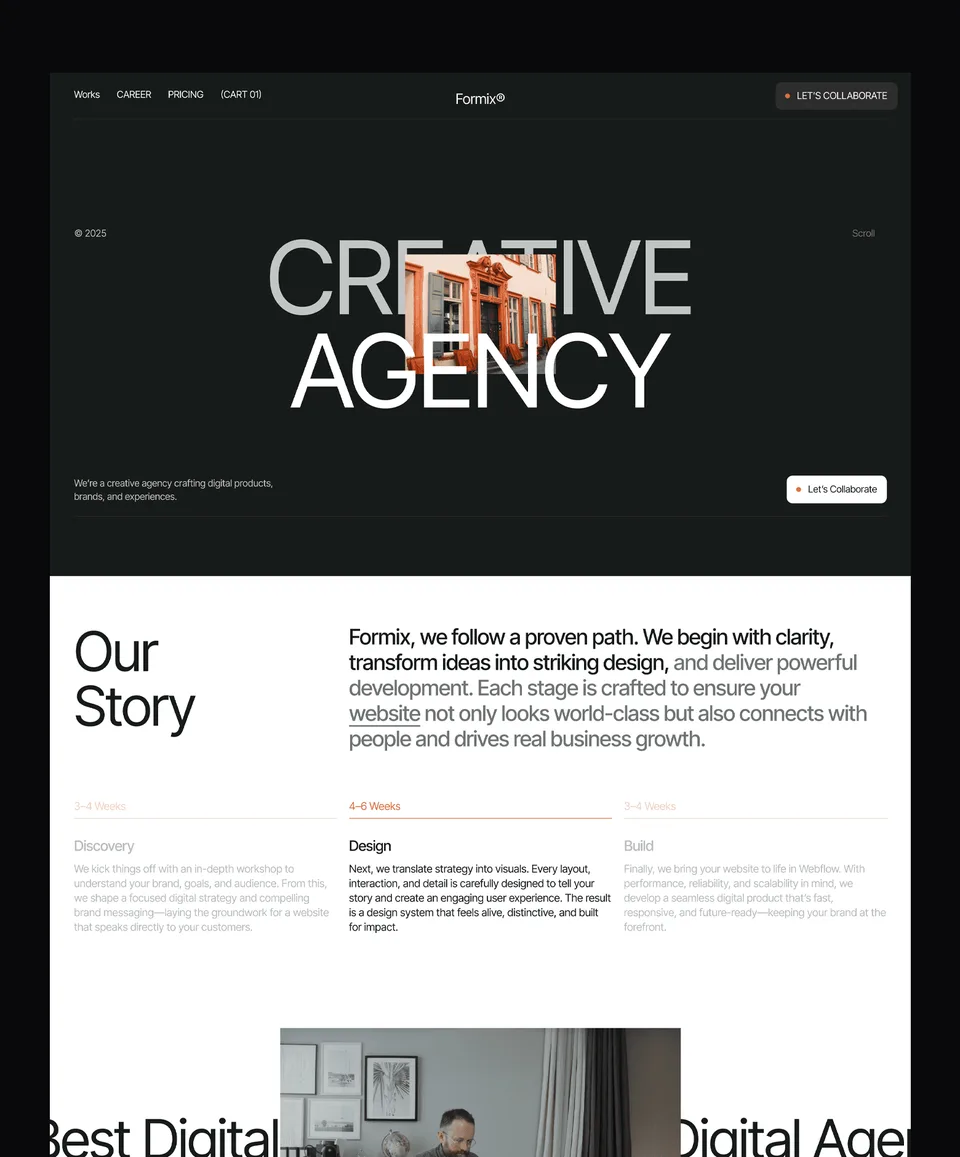
Formix is a 15-page portfolio and creative agency template. It suits a photographer who wants room for services, process and several project types alongside the gallery work.
All three are free on Framer with a free Waida account. You can browse every portfolio website template or the full set of free Framer templates.
Templates to start from
All 40 templates


Frequently asked questions
What pages should a photography website have?
A home page, a portfolio split by genre, an about page with a photo of you, a services or pricing page, and a contact or booking page. Client galleries usually live on a separate proofing platform linked from the menu.
How many photos should be in a photography portfolio?
Around 15 to 40 images per gallery is enough for most photographers. Edit hard, lead with your strongest frame, and show only the kind of work you want to be hired for.
How do I make a photography website load fast?
Export images at the size they are displayed, use WebP or AVIF, serve responsive sizes, and lazy-load images below the first screen. Do not lazy-load the hero image, because it is usually the largest element on the page.
Can I stop people from stealing photos on my website?
Not completely, because anything shown in a browser can be saved. Publish at web size, state your usage terms, and in the United States register your images with the Copyright Office, which allows up to 750 photographs in one group claim.
Should client proofing be on my portfolio website?
Usually not. A dedicated gallery platform handles private galleries, favourites, downloads and print sales better, and keeps full-resolution client files off your public site so it stays fast.
Are Waida Studio photography templates free?
Egnis, Golden Flash and Formix are free on Framer with a free Waida Studio account. Their Webflow, HTML, Next.js and Astro versions are paid, and Figma files are sold separately for $19.
Photography website design comes down to a short list: a portfolio edited to the work you sell, images that load fast on a phone, a services page that sets expectations, an easy way to book, and client galleries kept on a proofing platform. Get those right and the visual style can be as quiet or as bold as your work.
If you want the layout done for you, start from our portfolio templates. Egnis, Golden Flash and Formix are free on Framer with a free Waida account; their Webflow versions cost $59 to $79, and plans are on the pricing page. Every licence covers unlimited personal and client projects under our licence terms, and our customisation service can set the template up for you from $499.

More from Kazi
Related articles
More in Use Cases
Personal Portfolio Website: What to Include in 2026
What a personal portfolio website needs in 2026: the sections, one page or several, a domain with your name, where to build it and a launch checklist.

Church Website Design: What a Church Site Needs in 2026
What a church website needs in 2026: service times on the first screen, a plan-your-visit page, a sermon archive, licensed livestreams and a short giving path.

Nonprofit Website Design: What a Charity Site Needs in 2026
What a nonprofit website needs in 2026: a clear mission, a donate path that takes a few taps, the documents donors check, and a site that meets Google's Ad Grants policy.