Law Firm Website Design: What It Needs in 2026
What a law firm website needs in 2026: practice-area pages, attorney bios, a working intake path, and the advertising rules that govern every word on it.

A law firm website earns work when a stranger can find the practice area that matches their problem, read who would handle it, and start a conversation in one step. That means a page per practice area, real attorney bios, a phone number that never scrolls away, and a short intake form — inside whatever your state's advertising rules allow.
The Pages a Law Firm Website Needs
Eight page types cover most firms. Build the practice-area set first, because that is where search sends people. Everything else supports it: bios prove who does the work, results show it has been done, and contact turns a reader into a matter.
Page | What the visitor wants from it | Why it earns work |
|---|---|---|
Home | Which problems this firm handles, and where | Sorts the right visitor into the right practice area in one screen |
Practice area (one per area) | Whether this firm handles their problem | The page that ranks, and the page that converts |
Attorneys index | Who is in the firm | Lets a referral find the person they were told about |
Attorney bio | Credentials, jurisdictions, focus, a face | What a referral checks before picking up the phone |
Results or representative matters | Evidence the firm has handled this before | Carries the heaviest ethics constraints — see below |
Insights | Answers to the question they searched | Brings in the people who are not ready to call yet |
About | Size, history, values, offices | Answers the 'is this firm my size' question |
Contact | A phone number, an address, one form | The whole site exists for this |
Practice Area Pages Do the Ranking
People search for their problem, not for your firm. One page per practice area gives each of those searches its own heading, its own copy and its own call to action. A single Services page listing twelve areas cannot rank for twelve different intents.
Each practice-area page should carry the problem in the reader's own words, what the process looks like, a realistic timeline, how fees are calculated, who at the firm handles it, and one next step. Link from there to the attorney who runs the area and to two or three related insights. That internal linking is the same structure that makes a landing page design work: one page, one intent, one action.
Write the page for someone in the middle of a bad week. Short sentences, no Latin unless you define it, and the answer to "what happens if I call you" above the fold.
Attorney Bios Carry the Trust
The bio is where a referral checks you out. Give every lawyer their own URL, a real photograph rather than stock, and the facts a potential client is actually checking.
- Bar admissions, and the jurisdictions where the lawyer is licensed
- Practice focus, in plain words
- Education and any board certification, with the certifying organisation named
- Types of matter handled, without naming clients who have not consented
- Languages spoken
- A direct phone number or email, not just the firm's switchboard
- Publications, speaking and bar service, if they are current
If the firm has offices in more than one state, say which lawyers are licensed where. North Carolina's Rule 7.1 requires an interstate firm's office listings to indicate the jurisdictional limits on lawyers not licensed where that office sits. Check your own state's rule for the equivalent requirement.
The Intake Path, From Page to First Call
Intake is a path, not a form. Five steps cover it, and every one of them is a place where firms lose the matter.
- A phone number in the header on every page, tap-to-call on mobile
- One short form: name, contact, matter type, and a few lines about the situation
- A statement next to the form about what submitting it does and does not create
- An immediate confirmation that says what happens next and by when
- A booking link, if the firm takes scheduled consultations
Keep the form to five fields. You can ask the rest on the call, and every field you add is one more reason to abandon the form. If conflicts checking means you cannot accept detail up front, say so in one line rather than leaving the reader guessing.
The Advertising Rules That Govern Your Website
Your website is a communication about your services, so your state's rules of professional conduct apply to every word on it. The rules differ by state, so read your own. North Carolina publishes its rules in full, and they are a fair guide to the shape of the problem.
- No false or misleading communication about the lawyer or the lawyer's services, including a truthful statement that omits a fact needed to keep it from being misleading (Rule 7.1)
- Nothing likely to create an unjustified expectation about the results you can achieve — which is what a results page does if it lists wins without the facts behind them (Rule 7.1)
- No comparison with other lawyers' services unless the comparison can be factually substantiated (Rule 7.1)
- No claim to specialise unless the lawyer is certified by the state bar or an accredited organisation, and that organisation is named in the same communication (Rule 7.2(c))
- The name and contact information of at least one lawyer or firm responsible for the content; contact information can be a website address, telephone number, email address or physical office (Rule 7.2(d) and its comment)
Disclaimers do real work here. The comment to Rule 7.1 says an appropriate disclaimer or qualifying language may prevent a statement from being found to create unjustified expectations. That is why results pages and contact forms carry them. Read your own state's rule before you write the home page headline — some go further than the model, and none of this is legal advice about your jurisdiction.
Speed, Contrast and Structured Data
Three technical things are worth the effort on a firm's site: how fast it loads, whether the text is readable, and whether search engines can tell what the business is. Everything else can wait until the content is right.
Speed. Google's guidance on Largest Contentful Paint is 2.5 seconds or less at the 75th percentile of page loads. On a law firm site the usual culprit is an uncompressed hero photograph of the lobby.
Contrast. WCAG 2.2's contrast minimum is 4.5:1 for normal text and 3:1 for large text. Grey-on-white body copy fails it constantly, and a reader who cannot read your fee explanation does not call.
Structured data. Mark the firm up with schema.org LegalService, not `Attorney` — schema.org lists Attorney as deprecated and says LegalService is more inclusive and less ambiguous. LegalService inherits from LocalBusiness, so address, telephone, opening hours and areaServed all apply. If the term is new to you, the Waida glossary covers the web vocabulary.
Templates You Can Start From
Waida Studio has no law-firm template. It has professional services templates and business templates whose structure maps onto a firm: services, team, case studies, insights, contact. These four are the closest fits, and each needs new photography and new copy before it carries a firm's name.
Zelda, if the budget is zero

Zelda is a dark 13-page template built for design studios, and it is the one template that is free on Framer, Webflow, HTML, Next.js and Astro with a free Waida account — the Figma file included. Use it to test your page structure and intake copy before committing to a paid template.
For a firm it needs the most work of the four: the dark palette and studio language suit litigation boutiques more than estate planning practices. Swap the colour system first.
Oldage, the closest structural match

Oldage was built for elderly care, clinics and medical practices, and that is exactly why it fits a firm. It is the same job: a worried person, a service they do not fully understand, and a booking. Fourteen pages, with services, team, trust sections and an appointment path you can relabel as a consultation.
It is free on Framer with a Waida account, $59 on Webflow, $39 on HTML and $49 on Next.js or Astro. The Figma file is $19 separately.
Mariq, for a firm with case studies

Mariq is an 11-page marketing-agency template whose case-study structure maps onto representative matters, and whose CMS blog maps onto insights. If your firm wants to publish regularly, this is the one with the cleanest article layout.
Free on Framer with a Waida account, $79 on Webflow, $39 on HTML, $49 on Next.js or Astro.
GreenAxis, for a multi-practice firm

GreenAxis is the biggest structure in the catalogue at 53 pages: a project portfolio, a services set, a newsroom and a careers board. For a firm with eight practice areas, three offices and active hiring, that page count saves weeks. It ships on HTML, Next.js and Astro only — there is no Framer template or Webflow template version of it.
$39 on HTML, $49 on Next.js or Astro, and the Figma file $19. Delete the subscription tiers and cart it includes; a law firm has no use for them.
What a Law Firm Website Costs
Six routes, with real numbers. Platform hosting sits on top of all of them: Framer states that connecting a custom domain requires a paid plan, and Webflow's free Starter publishes only to a webflow.io subdomain. The Framer pricing breakdown and the Webflow pricing breakdown have the current figures.
Route | What you get | Price |
|---|---|---|
Free template | Zelda on any platform; Oldage, Mariq and others free on Framer, with a free Waida account | Free |
One template | One template, one platform, unlimited projects | $39 HTML, $49 Next.js or Astro, $49–$129 Framer or Webflow |
Platform bundle | Every template on that platform, lifetime | $159 Framer or Webflow, $99 HTML, Next.js or Astro, $49 Figma |
Pro or Ultra plan | Template credits, the full sections library; Ultra adds 3 seats | Pro $12/month billed yearly or $299 once; Ultra $36/month billed yearly or $699 once |
Customisation | Logo, copy, colours, images, up to 2 custom sections, 2 revision rounds | $499, seven-day delivery |
Custom build | Full custom design, CMS structure, Figma file included | $5,000 |
The Waida licence is one person, unlimited projects, personal, commercial and client work, with no attribution required. Ultra's team licence covers three seats. If you would rather hand the whole thing over, the customisation service covers the swap; the pricing page has current plan terms.
A template is the right call when your practice areas are standard and your differentiator is people, not interface. A custom build earns its price when you need something a template cannot hold — a matter portal, a document intake flow, a multilingual office set. The template versus custom breakdown works through that trade in detail.
Templates to start from
All 40 templates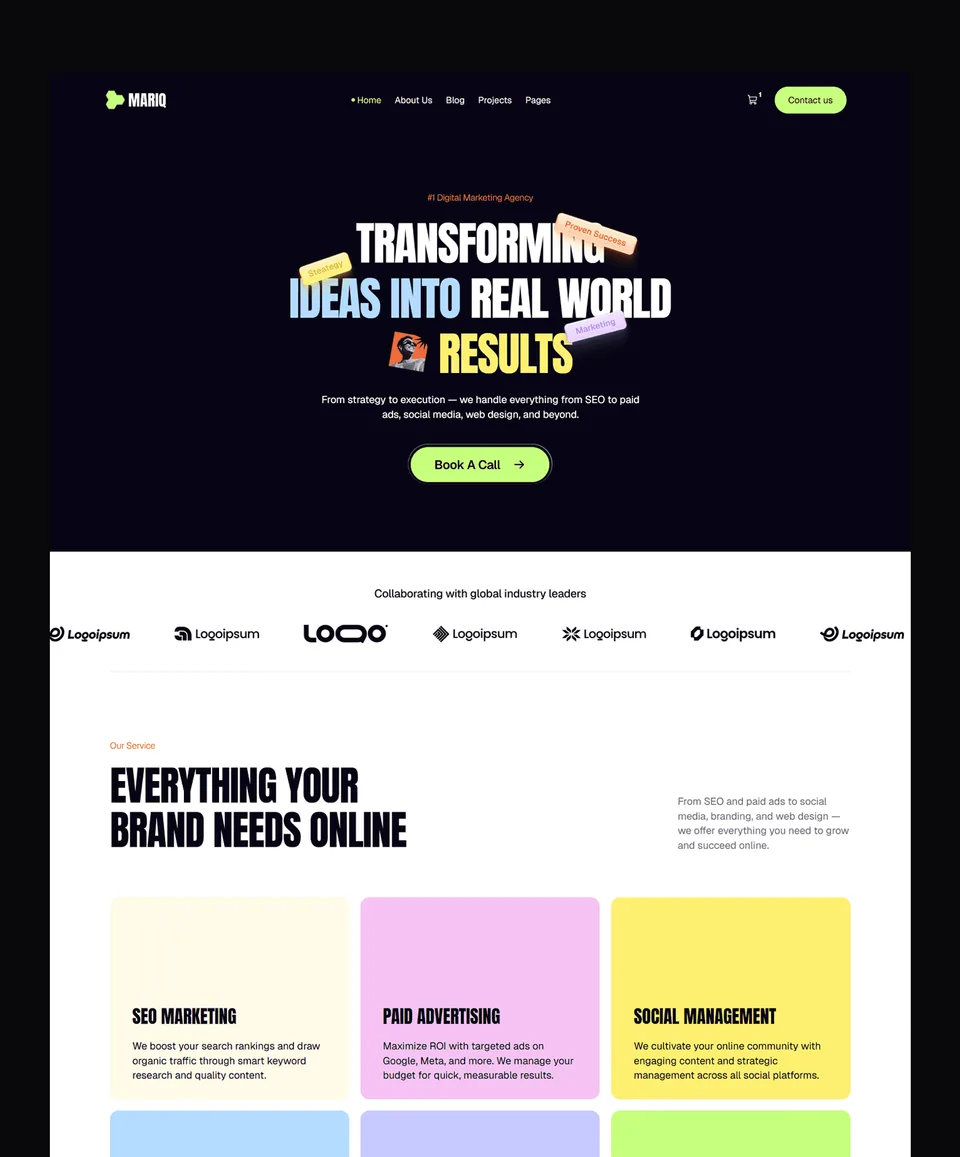




Frequently asked questions
What pages does a law firm website need?
Eight types: home, a page per practice area, an attorneys index, one bio per lawyer, results or representative matters, insights, about and contact. Practice-area pages matter most, because search sends people to the problem they have rather than to your firm's name.
Can a law firm use a website template?
Yes. No rule of professional conduct restricts the software behind your site — only what the site says. Choose a professional-services template, replace stock photography with real attorney photographs, and rewrite every claim before launch.
How much does a law firm website cost?
A Waida template runs free to $129 depending on platform, a customisation package is $499 with seven-day delivery, and a full custom build is $5,000. Framer or Webflow hosting is billed separately by the platform.
Do disclaimers on a law firm website matter?
Yes. The comment to North Carolina's Rule 7.1 says an appropriate disclaimer may prevent a statement from being found to create unjustified expectations. That is why results pages and contact forms carry them. Check your own state's rule.
What structured data should a law firm website use?
Use schema.org LegalService. Schema.org marks the Attorney type deprecated and says LegalService is more inclusive and less ambiguous. LegalService inherits LocalBusiness properties, so address, telephone, opening hours and areaServed all apply.
Can a law firm website call a lawyer a specialist?
Only under conditions. North Carolina's Rule 7.2(c) permits it when the lawyer is certified by the state bar or an accredited organisation, and that certifying organisation is named in the same communication. Other states set their own tests.
Start with the practice-area pages, because they are what search rewards and what converts. Then the bios, then one intake path you have actually tested on a phone. Design comes last, and a template settles it: the professional services templates run free to $99 depending on platform, and Zelda is free everywhere with a free account.
Firms adjacent to legal services face the same structure — the construction website design guide and the agency website design guide work through the trust-and-intake problem from different angles, and both apply here.

More from Kazi
Related articles
More in Use Cases
Best Free Portfolio Website Templates: 10 Picks for 2026
Ten free portfolio website templates for designers, photographers, filmmakers and developers, with the platform costs and licence limits spelled out.

Agency Website Design: What Wins Clients in 2026
What an agency website needs, in order, to turn visitors into clients, plus template, customisation and custom-build costs.

Best Next.js Landing Page Templates: 9 Picks for SaaS and Startups in 2026
Nine Next.js landing page templates for SaaS products and startups, from designed templates to free open-source starters, with who each one suits.