Template vs Custom Website: Which Should You Choose in 2026?
Template vs custom website in 2026 — real costs, timelines, and when each is worth it. Plus the middle path of template customization that most articles miss.
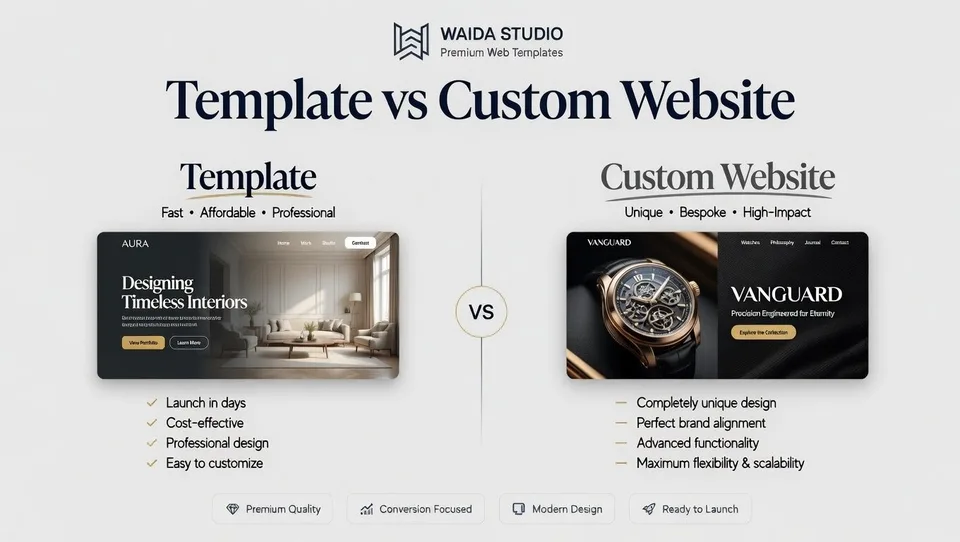
Templates are right when speed, budget, and "good enough" matter more than perfect fit; custom is right when brand differentiation, complex requirements, or strategic positioning justify the investment. A template is a pre-built design system you fill with content. A custom website is designed from scratch around your brand, audience, and business model. Most projects sit somewhere between the two.
This guide compares both approaches across cost, timeline, design ceiling, customization, scalability, ownership, and total cost of ownership. We also cover the middle path — template customization — which Waida Studio and many other studios offer as a deliberate bridge between the two extremes for projects that don't fit either neatly.
We sell templates and offer custom website builds at Waida Studio, so the bias here is balanced rather than tilted. We benefit from both options. We've written this comparison the way we'd want to read it from the buying side: honest about when a template is the smarter call and specific about when custom is genuinely worth 10–30× the price.
At a glance
Template (DIY or self-customized) | Template + customization service | Custom website | |
|---|---|---|---|
Cost | $30–$250 | $499–$2,500 | $5,000–$50,000+ |
Timeline | 1–7 days | 2–4 weeks | 6–16 weeks |
Design uniqueness | Generic to ~70% unique with effort | 80–95% unique | 100% unique |
Inner pages | Pre-built | Pre-built + brand-tailored | Designed from scratch |
CMS structure | Pre-built, may need adjustment | Pre-built + adjusted to needs | Built to spec |
Brand differentiation | Low | Medium-high | High |
Conversion optimization | Generic | Adapted | Built around your audience |
Best for | Tight budgets, fast launches, learning, validation | Brand-led businesses on a startup budget | Established companies, complex requirements, strategic positioning |
Ownership of design | Shared with other buyers | Mostly unique to you | Fully unique |
Long-term flexibility | Constrained by template structure | Mostly flexible | Fully flexible |
What you actually get with a template
A template — whether free or premium — is a pre-built website design and structure you populate with your content. You buy or download the file, set it up on your platform, replace placeholder content with yours, and publish. The faster path between idea and live site, by a wide margin.
What's typically included with a quality premium template:
- A complete homepage and 5–15 inner pages, all designed
- Full CMS structure for any dynamic content (blog, projects, products)
- Responsive layouts across desktop, tablet, mobile
- SEO-ready metadata fields
- Setup documentation and email support
- Free updates as platforms evolve
- A standard commercial license
What you give up:
- Brand differentiation. Your site looks similar to other sites built on the same template. For brand-led businesses, this matters.
- Strategic design. Templates are built for general categories ("agency," "portfolio," "SaaS"), not for your specific positioning, audience, or competitive landscape.
- Custom functionality. If your project needs anything outside the template's scope (custom calculators, complex form logic, niche integrations, unique CMS structures), you're either modifying the template heavily or moving to custom.
- Pixel-precise brand expression. Templates use their own design language. Your brand has to fit within it rather than dictate it.
For many projects, none of this is a problem. A small business marketing site, a designer portfolio, a freelancer website, a startup MVP — these projects often work fine on a template. The template's constraints are protective rather than limiting.
What you actually get with a custom website
A custom website is designed and built from scratch around your specific brand, audience, business model, and strategic goals. The process involves discovery, brand alignment, wireframing, visual design, multiple revision cycles, custom development, CMS engineering, integration setup, and launch quality assurance.
What's typically included with a custom build:
- Discovery and strategy phase (audience research, competitive analysis, positioning)
- Wireframes and information architecture designed for your specific funnel
- Custom visual design built around your brand identity
- Multiple revision cycles with stakeholder approval
- Custom-built CMS structures matched to your editorial workflow
- Custom integrations (CRM, analytics, marketing automation, third-party services)
- Conversion optimization built into design decisions, not retrofitted
- Performance optimization (custom sites typically score 90+ on speed benchmarks vs 70–80 for templates)
- Cross-browser and accessibility testing
- Launch QA, redirects, analytics setup
- Post-launch support and iteration
What you give up:
- Speed. Custom builds typically take 6–16 weeks; complex projects run longer.
- Cost. Custom websites start around $5,000 for small projects and run to $50,000+ for complex enterprise builds. Industry benchmarks for 2026 put a typical small business custom site at $5,000–$15,000 and a mid-size B2B build at $15,000–$40,000.
- Predictability. Custom projects involve real discovery and revision; the final site rarely matches the initial concept exactly.
- Iteration friction. Major design changes after launch require designer/developer time, not a quick visual edit.
The middle path: template customization
Most projects don't fit cleanly into "pure template" or "fully custom." A template gets you 70% of the way to your ideal site; the remaining 30% — brand fit, custom sections, modified CMS structure, integration work — is where projects either compromise or move to custom.
Template customization services bridge this gap. You start with a premium template and have a designer adapt it to your brand: replace fonts and colors with your design system, modify sections to fit your content, add or remove pages as needed, configure CMS structures to match your workflow, and integrate with the tools you actually use.
The output is a site that's 80–95% unique to your brand at a fraction of the cost of building from scratch, in 2–4 weeks rather than 2–4 months. The trade-off is that you're working within the template's structural foundation; if your project needs fundamentally different architecture (very different page types, complex custom functionality), customization can't fix that, and you're back to custom.
This is the model Waida Studio offers at $499 — start with one of our templates, we customize it to your brand, you ship in weeks instead of months. It's not the right path for every project, but for early-stage companies, brand-led businesses on tight budgets, or anyone who likes a specific template but needs it to look like their site rather than a generic version, it solves a real problem.
When a template is the right choice
A pure template approach is the right choice when:
- Budget is the primary constraint. A template plus your time costs $0–$250. Custom starts at $5,000+. If the difference is meaningful for your project, templates win on math.
- Speed matters more than perfect fit. You can launch a template-based site in days. Custom takes weeks to months. For pre-launch landing pages, MVPs, conference sites, or anything time-sensitive, templates ship faster.
- The project is small or temporary. A 5-page brochure site, a personal portfolio, a side project, an event website — these don't justify custom investment.
- You're validating a concept. Pre-product-market-fit, the website is one of many things changing rapidly. Don't sink $15K into a custom site for a positioning that may not exist in 6 months.
- Your brand isn't yet a strategic differentiator. For early-stage companies, brand-driven design isn't yet a competitive advantage. A template that looks professional is enough.
- You're comfortable with platform constraints. Templates are built for specific platforms (Webflow, Framer, WordPress, Shopify) with their own conventions. If you're fine working within those, templates work well.
When custom is the right choice
A fully custom build is the right choice when:
- Brand differentiation is strategic. If you compete in a category where many sites look similar, custom design can be a real competitive advantage. Established companies in design-conscious industries (creative agencies, premium brands, design tools, design-led SaaS) often need this.
- Your requirements don't fit any template. Custom CMS structures, complex form logic, niche integrations, unusual page types, multi-tenant architecture — when no template can handle the project, custom is the only option.
- You're investing in conversion optimization. Custom sites can be designed around your specific funnel, audience research, and conversion data. Templates optimize for general patterns; custom optimizes for your patterns.
- The project is mission-critical and long-term. A site that's central to a $10M business and will run for 5+ years justifies a $20K+ investment in getting it exactly right. The amortized cost is low.
- You have the budget. $5,000–$50,000+ requires real budget allocation. If that budget exists and the project warrants it, custom delivers value templates can't match.
- You need full ownership of the design. Custom designs are uniquely yours. No other company has the same site. For brand-led businesses, this matters.
- Performance is a hard requirement. Custom sites typically score 90+ on Core Web Vitals; template sites often score 70–80. For sites where speed materially affects conversion or rankings, this gap matters.
When template customization is the right middle path
Template customization (the $499–$2,500 range) is the right choice when:
- You want a brand-distinct site without custom budget. Customization gets you 80–95% of the way to a fully unique site at 5–10% of the cost.
- You like a specific template but it's not "yours" yet. A template that's structurally right but visually generic is the perfect customization candidate. Adapt the design to your brand, ship in weeks.
- Your project doesn't need fundamentally different architecture. If the template's structure fits your needs (right page types, right CMS structure) but the design doesn't fit your brand, customization solves it.
- Speed and cost both matter. Custom takes months and costs thousands; pure template doesn't fit your brand. Customization is the answer for projects that need both speed and brand fit.
- You're scaling past "any template will do." Companies that initially launched on a generic template often hit a point where the generic look starts hurting brand perception. Customization upgrades the existing site without a full custom rebuild.
Total cost of ownership
The 3-year cost picture matters more than upfront cost.
Template (DIY): Year 1 cost ~$130 (template + domain). Year 2–3 ~$130/year. Total 3-year: ~$400. Hidden costs include 20–60 hours of personal time on setup, customization, and platform-update fixes.
Template + customization service: Year 1 cost ~$650 ($499 customization + template + domain). Year 2–3 ~$130/year. Total 3-year: ~$900. Time investment is minimal — the studio handles customization.
Custom website: Year 1 cost ~$8,000 (small business custom build). Year 2–3 ~$300/year (hosting, domain, minor maintenance). Total 3-year: ~$8,600. Major redesign at year 4–5 typically adds $5,000–$15,000.
The break-even calculation: A custom site costs ~10× more than template customization upfront. The return justifies that cost when the site genuinely affects business outcomes — conversion rates, brand perception in competitive categories, complex functional requirements, or strategic positioning. For sites where these factors don't apply, the cost difference is hard to justify.
Decision matrix
Your situation | Recommended | Why |
|---|---|---|
Personal portfolio (5–10 projects) | Template | Project size, low-stakes, no commercial component |
Freelancer website | Template + light customization | Brand differentiation matters but budget is constrained |
Pre-launch SaaS landing page | Template | Validation phase, content will change |
Established SaaS marketing site | Custom | Conversion optimization, brand strategy |
Local service business | Template + customization | Brand fit matters; full custom is overkill |
Customization or custom | Brand differentiation is a sales tool | |
Real estate broker site | Template + customization | Industry templates exist; customization for brand |
Real estate listing platform | Custom | Complex functional requirements |
Restaurant or local retailer | Template | Templates fit these archetypes well |
E-commerce store (small catalog) | Template | Webflow Ecommerce or Shopify templates work |
E-commerce store (complex/scaling) | Custom | Custom checkout flows, complex variants, B2B logic |
Side project or MVP | Template | Validation phase, low investment justified |
Established consultancy / professional services | Customization | Brand matters, but architecture is standard |
Premium consumer brand | Custom | Brand differentiation is the entire game |
Internal tool or microsite | Template | Function over form |
Investor-facing company site | Customization or custom | Perception matters; choose based on stage |
If a template is the right call, the catalogue covers Framer, Webflow and code. If it is close but not quite, our customization service is the middle path this article describes.
Frequently asked questions
How much does a custom website cost in 2026?
Realistic 2026 benchmarks: $3,000–$8,000 for small business sites with 5–10 pages from a freelancer. $5,000–$15,000 for professional small business sites from agencies. $15,000–$40,000 for mid-size B2B builds with complex CMS and integrations. $40,000+ for enterprise builds with custom functionality. E-commerce custom builds range $5,000–$40,000+ depending on catalog size and checkout complexity. Pricing varies by region, agency size, and project scope.
How long does a custom website take vs a template?
Template-based sites typically launch in 1–7 days for DIY work or 2–4 weeks with a customization service. Custom websites typically take 6–16 weeks: 2–3 weeks for discovery and design, 4–8 weeks for development, 1–2 weeks for QA and launch. Complex custom projects can run 4–6 months. Templates are roughly 5–20× faster to launch than custom.
Will a custom website rank better in search than a template?
Templates and custom sites can both rank well — content, site structure, backlinks, and technical SEO matter far more than design origin. However, custom sites typically have cleaner code, faster page speeds (90+ Core Web Vitals scores vs 70–80 for templates), and better SEO infrastructure built in from the start. The compounding effect over time is real but indirect; for most small business sites, the difference doesn't determine rankings.
Can I start with a template and move to custom later?
Yes, and many companies do. The typical path: launch on a template in pre-launch or early-stage, customize it after initial traction, move to fully custom when the business genuinely needs strategic differentiation or complex functionality the template can't deliver. Migration usually happens during a planned redesign rather than as a clean port — the custom site is built fresh with content imported from the template-based site.
Is a template-based site less professional than custom?
Not inherently. A well-customized premium template often looks more professional than a poorly-executed custom site. Customer perception depends more on visual quality, content, and brand consistency than on whether the underlying design started as a template. The "less professional" perception applies mostly to obviously templated sites — sites where the original template's design language hasn't been adapted at all.
When is template customization worth it over going fully custom?
Template customization is worth it when the template's structure already fits your needs (right page types, right CMS configuration) but the visual design needs to be adapted to your brand. If you'd choose a custom site primarily for visual brand fit rather than for functional or architectural requirements, customization typically delivers 80–95% of the value at 5–10% of the cost. If your project needs fundamentally different architecture or custom functionality the template can't accommodate, customization can't bridge that gap and custom is the right path.
Looking for the right path? Our template library covers Framer, Webflow, HTML, Next.js, Astro and Figma — 35+ designs across portfolios, agencies, SaaS, and business sites, starting at single-template purchases. For brand-distinct sites without custom budget, our Customization service adapts any template to your brand for $499. For fully custom builds where strategic differentiation justifies the investment, our Custom Website service starts at $5,000.
Pillar guides:

More from Kazi
Related articles
More in Comparisons
Framer vs Wix: Which Builder Is Right for Your Site in 2026?
Framer vs Wix in 2026 — design control, e-commerce, AI features, learning curve, and pricing. Honest comparison from a Framer studio.
Framer vs Figma Sites: Which Is Right for Your Site in 2026?
Framer vs Figma Sites in 2026 — production maturity, design environment, CMS, animations, and pricing.
Premium vs Free Website Templates: Which Should You Choose in 2026?
Premium vs free website templates in 2026 — what's actually included, hidden costs of free, and when each is genuinely the right choice. From a template studio.