Agency Website Design: What Wins Clients in 2026
What an agency website needs, in order, to turn visitors into clients, plus template, customisation and custom-build costs.
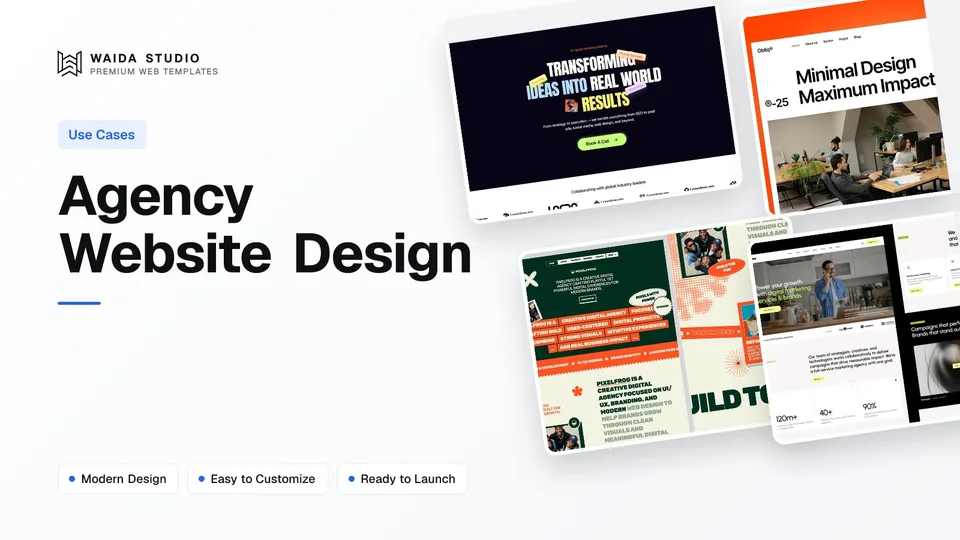
Agency website design wins clients when the site does five jobs in order: say what you do within seconds, prove it with real work, list services clearly, explain how a project runs, and make it easy to start a conversation. Get those right and colour, animation and typography matter far less than most agencies think.
Say What You Do Before Anyone Scrolls
The first screen has one job: tell a visitor what kind of agency this is and who it's for, without making them scroll or guess. A headline like "We build brands that grow" says nothing an insurance company's site couldn't also claim. "Brand identity and web design for consumer startups" says who you serve and what you deliver in one line.
Pair that line with a sub-headline naming the outcome clients hire you for, and a single call to action. Two competing buttons, one for "See our work" and one for "Get in touch", split attention; pick the one that matches where most visitors are in their decision and make it the only button above the fold.
Show the Work, With Outcomes Not Just Images
A gallery of screenshots proves you can design a site. It doesn't prove you can solve the problem a prospective client actually has. Each case study should say what the client needed, what you changed, and what happened afterwards, even a plain, unquantified outcome like "the client relaunched with a homepage built around one signup flow instead of four" tells a visitor more than a hero image on its own.
Three to six case studies is enough for most agencies; a wall of twelve thin ones reads as filler. If your case studies live in a CMS collection rather than as hand-built pages, you can add or retire one without touching the template's layout. Most of Waida's agency templates build their project pages this way, on Framer CMS or Webflow CMS depending on platform.
List Services Like a Menu, Not a Manifesto
Visitors scan a services section looking for one thing: does this agency do the specific thing I need? A paragraph of positioning language buries that answer. Name each service in plain terms, such as "Brand identity", "Website design" or "Ongoing content", with one line on what's included and, where you're comfortable sharing it, a starting price or a range.
Waida's own pricing page works on the same idea: tiers named plainly, each with what it includes listed underneath, so a visitor can match themselves to one without reading a sales pitch first. An agency's services section can borrow that structure directly.
Explain How a Project Actually Runs
A process section isn't decoration; it answers the question every prospective client is actually asking, which is "what happens if I say yes?" Four or five steps, covering discovery, design, build, launch and what support looks like afterwards, with a rough timeframe for each, removes most of the uncertainty that keeps a visitor from filling out a contact form.
Keep the steps generic enough to be true for most projects and specific enough to be useful: "a working prototype by week two" tells a visitor more than "we design collaboratively".
Make Contact the Easiest Step on the Site
Every section before this one exists to get a visitor to this one. A contact form asking for a name, email and a short project description converts better than one asking for budget, timeline, company size and how they heard about you before it will even accept the message. Ask the qualifying questions on a call, not before you've earned one.
Repeat the call to action at the bottom of the page, not only in the header. A visitor convinced by your case studies shouldn't have to scroll back up to act on it.
Build It Yourself, Customised, or Fully Custom
Approach | Typical cost | Timeline | Best for |
|---|---|---|---|
A premium agency template | $39–$129 depending on platform | Live the same day | Agencies happy to write their own copy and drop in their own case studies |
Template customisation | $499, one-time | 7-day delivery | Agencies who want their branding and copy built into a template's existing structure |
A fully custom website | $5,000, scope-dependent | Timeline varies | Agencies with a structural need a template can't meet, or who want a Figma file built alongside the site |
Waida's own customisation service prices template customisation and fully custom builds this way today. A template you buy outright and edit yourself sits underneath both, at the price of the template alone.
Waida's 20 Agency Templates Are Built on This Structure
Waida Studio has 20 agency templates across Framer, Webflow, HTML, Next.js and Astro, and each one already puts positioning, work, services, process and contact in this order. It's how they're built, not a theory applied afterwards. Picking one is a starting point, not a compromise.
For a side-by-side comparison of which Framer agency template suits which kind of agency, see Best Framer Agency Templates: 10 Picks for 2026.
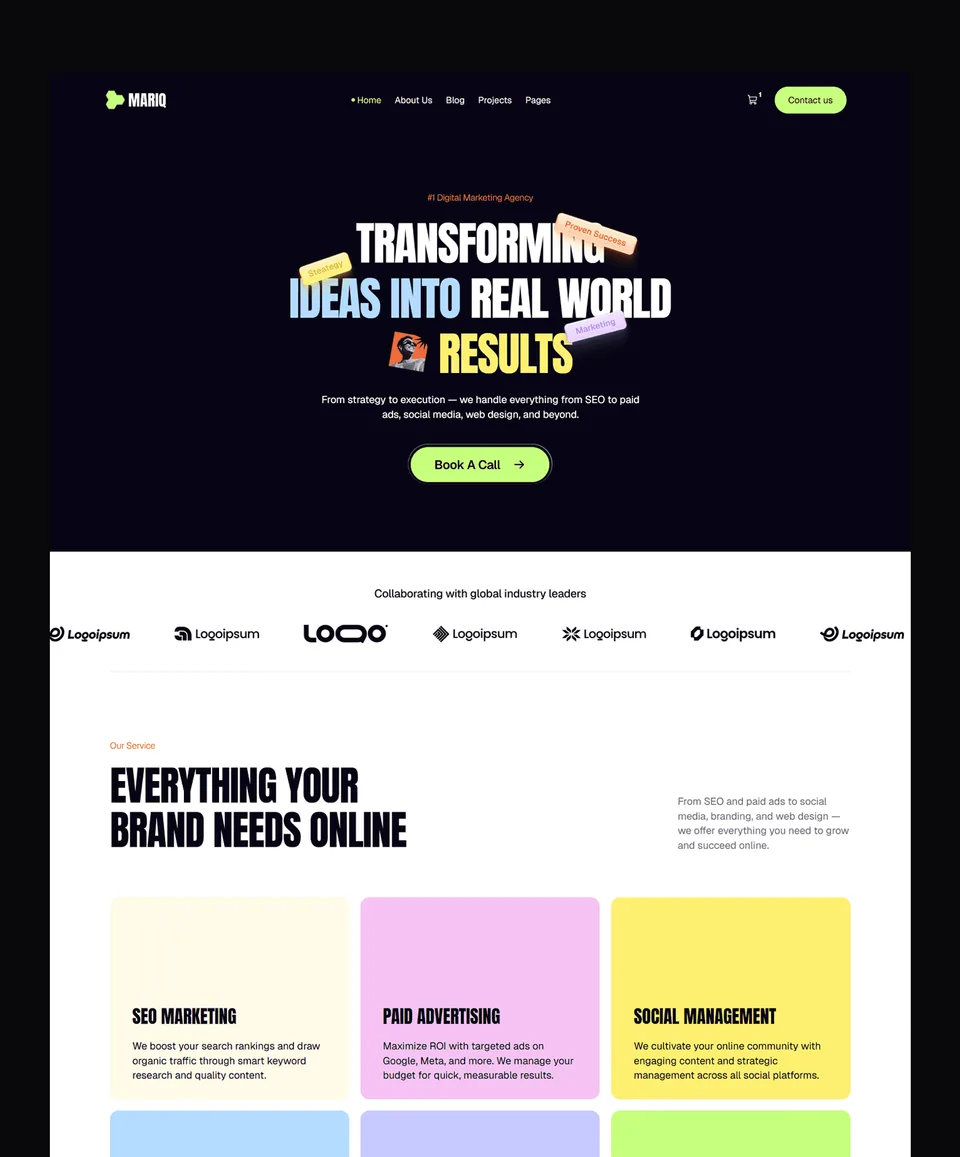
Mariq, for marketing agencies that sell results
Mariq is free on Framer and built for marketing agencies, startups and creative teams. Its CMS-powered pages carry services and case studies, so the site doubles as a portfolio and a sales page.

Obliq, for design studios that want work and case studies together
Obliq is a portfolio and agency template, free on Framer, built for design agencies that want to present their own creative work and their client-facing case studies within the same site.

PixelFrog, for agencies that want a clear, professional structure
PixelFrog is built for agencies, studios and marketing teams that want to showcase services, projects and brand identity with clarity, at $79 on Framer.

Agency templates
All 23 agency templates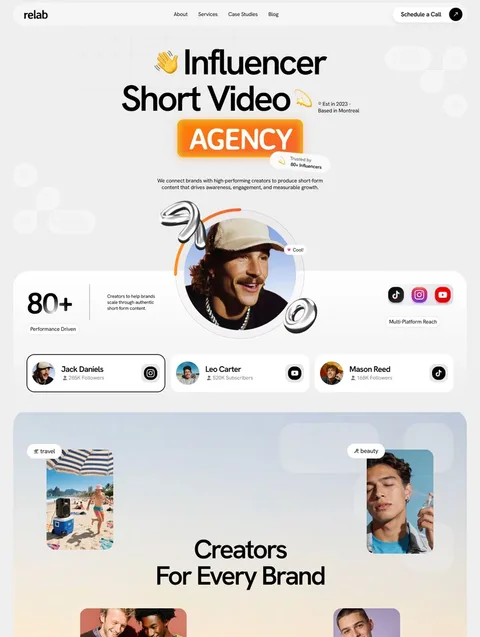


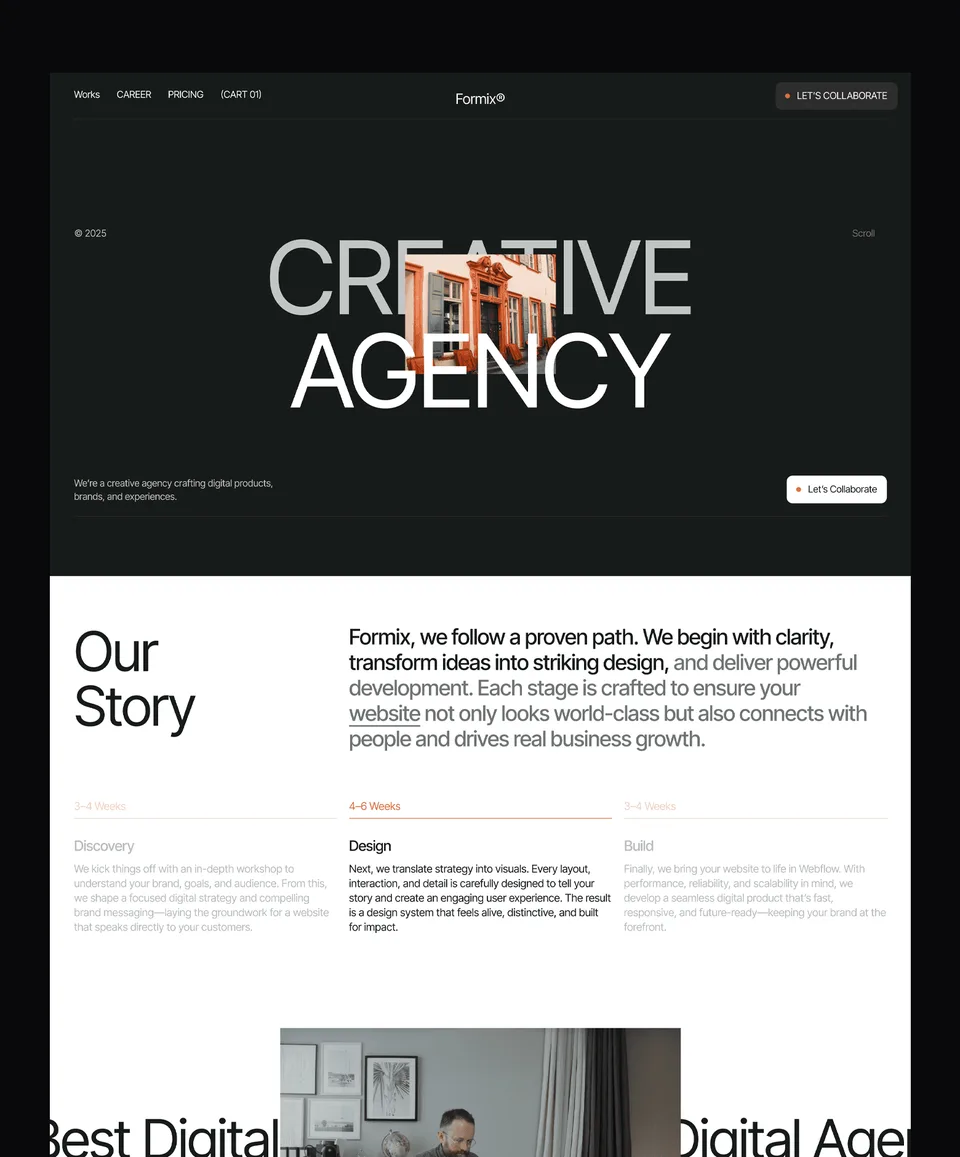
Frequently asked questions
How long should an agency website take to build?
With a template, a working site can launch the same day you buy it, once you've swapped in your own copy and case studies. A template customisation service, such as Waida's at $499, typically takes about a week; a fully custom build takes longer and depends on scope.
Should an agency website show pricing?
Even a starting price or a range reduces friction, because it lets a visitor self-select before they contact you. Full transparency isn't required; a range like "projects typically start at $X" does most of the work.
What's the difference between a portfolio site and an agency site?
A portfolio site sells one person's work; an agency site sells a team's process and results. An agency site needs a services section and a process section that a solo portfolio usually doesn't.
Does an agency website need a blog?
Not to win a client directly, but a blog or CMS-powered insights section gives you pages to rank for the terms clients search before they know your name, and it's a natural place to publish case studies as they happen.
How many case studies does an agency need on its homepage?
Three to six is typical. Fewer looks thin; more than that is better organised on a dedicated work page that the homepage links to, rather than scrolled past.
An agency website doesn't need to be original to win a client; it needs to answer, in order, what you do, what you've done, what you offer, how it works, and how to start. Waida's agency templates start free on Framer and from $39 on HTML, with every platform's version built on the same structure, so you can launch this week and spend your time on the case studies instead of the layout.
If the structure fits but the branding doesn't, template customisation puts your logo, copy and colours into it for $499. If nothing in the catalogue fits the way your agency actually works, a fully custom build starts at $5,000.

More from Kazi
Related articles
More in Use Cases
Ecommerce Website Design: What Sells in 2026
What an online store's website needs in 2026: clear product pages, an honest checkout, the right platform for your catalogue and a fast, well-described site.
Architecture Website Design: What Wins Commissions in 2026
What an architecture firm's website needs in 2026: a projects archive clients can browse by type, full project pages, fast photography and a clear enquiry path.
Roofing Website Design: What Wins Roofing Jobs in 2026
What a roofing website needs in 2026: a call button for leaks, a quote path for replacements, proof of licence and insurance, and a page per area you serve.