Roofing Website Design: What Wins Roofing Jobs in 2026
What a roofing website needs in 2026: a call button for leaks, a quote path for replacements, proof of licence and insurance, and a page per area you serve.
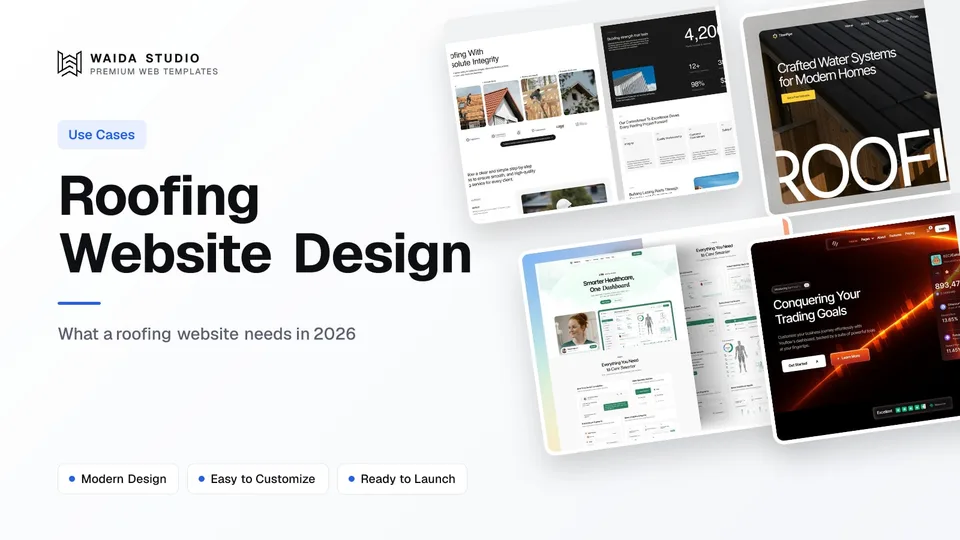
Good roofing website design does three jobs: it gets a homeowner with a leak on the phone in one tap, it gives a homeowner planning a replacement a clear way to request an inspection, and it proves you are licensed, insured and local before either of them calls a competitor.
This guide covers the pages a roofing company needs, the proof homeowners look for, how to set up service-area pages and your Google profile, the speed targets worth hitting, and what a roofing site costs when you start from a template. If you run a broader building firm, the construction website design guide is the wider version of this one.
The Pages a Roofing Website Needs
Seven page types cover most roofing companies, from a two-truck crew to a multi-branch contractor. Service pages and service-area pages do most of the work in search; the project gallery and the about page do most of the persuading. Every page ends in the same two actions: call now or book an inspection.
Page | What the homeowner wants from it | Why it earns jobs |
|---|---|---|
Home | Do you fix my kind of roof, in my town, soon? | Sorts emergencies from planned work in one screen |
Services (one per service) | Repair, replacement, inspection, gutters: what each involves | Gives each search its own landing page |
Service areas (one per town) | Do you actually work where I live? | Matches the "roofer near me" searches that bring calls |
Projects or gallery | Before-and-after photos of roofs like mine | The strongest proof a roofer can publish |
Storm and insurance work | Will you help with my insurance claim? | Answers the question behind most storm-season calls |
About | Who owns the company, how long you have been around, your licence | Homeowners hire people they can check |
Contact or Free Inspection | How do I book, and what happens next? | The page every other page points to |
If you only offer one service in one town, a single long page can hold most of this. Our guide to services landing page design walks through that format section by section.
Design the First Screen for Two Kinds of Visitor
A roofing site gets two very different visitors, and the first screen has to serve both. One has water coming through the ceiling and wants a phone number now. The other is comparing three roofers for a replacement next spring and wants to see your work, your warranty and a way to book an inspection.
- A tap-to-call phone number in the header, visible without scrolling on a phone. Make it a real tel: link, not an image of the number.
- One plain headline naming the service and the area: "Roof repair and replacement in Tulsa and Broken Arrow" beats "Quality you can trust".
- A second button for planned work, such as "Book a free inspection", leading to a short form: name, phone, address, and what is wrong.
- Emergency hours, stated honestly. If you answer at night, say so. If you don't, say when you call back.
- A photo of your own crew or a roof you finished, not a stock image of a smiling model in a hard hat.
Keep the inspection form short. Every extra field is a reason to call someone else instead. Ask for the roof's age and material on the phone, not in the form.
Proof Homeowners Check Before They Call
Roofing buyers are wary because the job is expensive and hard to check from the ground. Put the proof where they can see it without asking: your licence number, your insurance, your warranty terms and real reviews, each one checkable.
- Licence number in the footer and on the about page, where your state or city requires one, so a homeowner can look it up.
- Insurance. Say you carry liability and workers' compensation cover if you do, and offer a certificate on request.
- Warranty terms in writing. Separate your workmanship warranty from the manufacturer's material warranty, and state the length of each.
- Manufacturer certifications, only the ones you currently hold, with the badge linking to your listing on the manufacturer's own contractor finder.
- Before-and-after photos of real jobs, with the town and the work done ("full tear-off, architectural shingles, Owasso").
Reviews need care. In the US, the FTC's Consumer Reviews and Testimonials Rule went into effect on October 21, 2024. It bans fake or false reviews, rewards that depend on a review being positive, and threats used to get a bad review removed. Quote real customers with their permission, link to your Google reviews, and never write one yourself.
Service-Area Pages and Local Search
Most roofing work comes from local searches, so build one page per town you genuinely serve and set up your Google Business Profile to match. A service-area page should say what you have done in that town, how fast you get there, and show a project or two from it. A page that only swaps the town name is thin and rarely ranks.
Google treats most roofers as service-area businesses. Its Business Profile help page on service areas says to remove your address if you don't serve customers there, and that you can set up to 20 service areas by city, postal code or other area, but not as a radius. The overall area shouldn't be more than about two hours' drive from where the business is based.
Google's Local Services Ads list roofers as an eligible category. The Local Services Ads overview describes a Google Verified badge for businesses that pass Google's screening, and you pay only for leads related to the services you offer. If you run them, make sure the services and areas on your website match the ones in the ad profile.
- Use the same business name, phone number and service areas on the website, the Google profile and every directory listing.
- Give each service page its own title, such as "Roof Replacement in Tulsa | Your Company", rather than one title copied across the site.
- Add a short FAQ to each service page with the questions you hear on the phone: how long a replacement takes, whether you handle permits, what happens if it rains mid-job.
Speed and Mobile: The Targets Worth Hitting
Most homeowners with a leak search on a phone, often on a weak connection, so a roofing site has to load fast on mobile. Google's Core Web Vitals guidance sets the bar: the largest element on screen within 2.5 seconds, interactions answered within 200 milliseconds, and a layout shift score of 0.1 or less, measured at the 75th percentile of page loads.
Metric | Good threshold | What usually breaks it on a roofing site |
|---|---|---|
Largest Contentful Paint (LCP) | 2.5 seconds or less | A full-width hero photo uploaded straight from a phone camera |
Interaction to Next Paint (INP) | 200 milliseconds or less | Heavy chat widgets and review carousels loading at once |
Cumulative Layout Shift (CLS) | 0.1 or less | Badges and review widgets that pop in after the page draws |
Compress project photos before you upload them, keep one chat or callback tool rather than three, and give badge images a fixed size so the page doesn't jump. On Framer or Webflow, hosting is part of the plan, so there is no server for you to manage.
Roofing Website Templates to Start From
A template gets you the page structure above on day one, so the time goes into your photos, your areas and your licence details instead of layout. Two templates in the Waida Studio catalogue were designed for roofing companies. They are our own, so weigh that; both are listed with their real prices.
Steelcrest — for roofers and contractors

Steelcrest is built for roofing companies, contractors and home service businesses, with 13 pages covering services, projects and the sections a quote-driven business needs. It costs $79 on Framer or Webflow, $39 as HTML, and $49 for Next.js or Astro; the Figma file is sold separately for $19.
TitanPipe — free on Framer

TitanPipe is a roofing and home services template with 11 pages and a strong visual hierarchy for presenting services. It is free on Framer with a free Waida account, and $79 on Webflow, $39 as HTML, and $49 for Next.js or Astro. It is a sensible place to start if the budget is tight.
Both sit in the business website templates category, alongside other templates that adapt well to trades. Our free Framer templates are worth a look too if you want to start without spending anything.
What a Roofing Website Costs
A template-built roofing site costs between nothing and a few hundred dollars to launch, plus hosting from about $10 to $25 a month. The main costs are the template, the platform plan and any help you pay for. Prices below were checked on each provider's own page on October 15, 2026.
Item | Price | Notes |
|---|---|---|
TitanPipe on Framer | Free | With a free Waida account |
Steelcrest on Framer or Webflow | $79 one-off | Or included with a Waida Pro or Ultra plan credit |
Framer Basic plan | $10/month, billed yearly | Custom domain, 30 pages (framer.com/pricing) |
Webflow Basic / Premium | $15 / $25 a month, billed yearly | Basic has no CMS; Premium adds the CMS (webflow.com/pricing) |
Waida template customisation | $499 one-off | Logo, copy, colours, images, up to 2 custom sections, 7-day delivery |
Waida custom website | $5,000 one-off | Full custom build; timeline varies |
Framer's free plan only publishes to a Framer domain and is described as ideal for non-commercial use, so a roofing business should budget for a paid plan. For a fuller breakdown, see how much a website costs, and if you would rather hand the setup over, our customisation service does it for $499.
Templates to start from
All 42 templates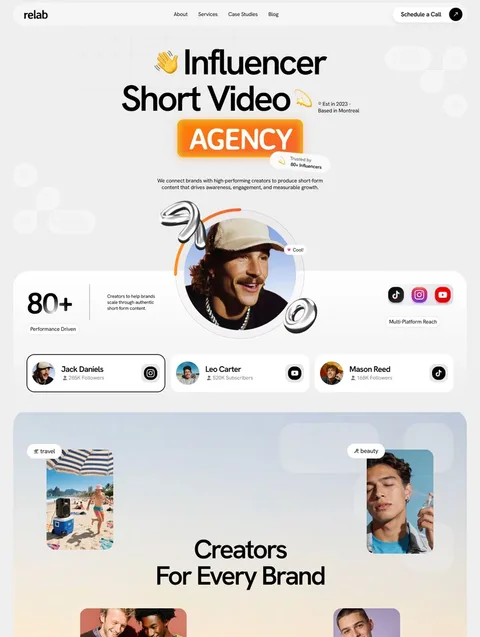



Frequently asked questions
What should a roofing website include?
A tap-to-call phone number, a short inspection request form, a page per service and per town you serve, before-and-after project photos, your licence number, insurance and warranty terms, and real reviews from customers.
How many service areas can a roofer set on Google?
Google Business Profile allows up to 20 service areas, set by city, postal code or other area rather than a radius. Google says the overall area shouldn't be more than about two hours' drive from the business.
Can roofers use Google Local Services Ads?
Yes. Roofers are an eligible category for Google Local Services Ads, which charge only for leads related to your services and can show a Google Verified badge once the business passes Google's screening.
How much does a roofing website cost?
Built from a template, a roofing website costs from nothing to about $79 for the template, plus a platform plan from about $10 to $25 a month. A done-for-you customisation from Waida Studio costs $499.
Is there a free roofing website template?
Yes. TitanPipe, a roofing and home services template from Waida Studio, is free on Framer with a free Waida account. The Webflow, HTML, Next.js and Astro versions are paid.
Should a roofing website show prices?
Most roofers can't quote a fixed price before an inspection, but a starting price or a typical range for common jobs helps homeowners decide to call. Say clearly that the final quote follows an inspection.
A roofing website that wins jobs is simple: a phone number you can tap, a short inspection form, a page for each service and each town you serve, and proof a homeowner can check. Get those right before you spend time on animation or extra pages.
Start from TitanPipe, free on Framer with a Waida account, or Steelcrest at $79, browse the rest of the professional services templates, and every Waida licence covers unlimited projects, including client work, under our licence terms.

More from Kazi
Related articles
More in Use Cases
Consulting Website Design: What Wins Clients in 2026
What a consulting website needs in 2026: a sharp positioning line, case studies with numbers, one booking path, and proof of who does the work.

Startup Website Design: What to Build at Each Stage in 2026
What a startup website needs before launch, at launch and while growing, with the pages, home page sections, platform costs and templates for each stage.
How to Make a Website for Small Business: 7 Steps for 2026
How to make a small business website in seven steps: set one goal, plan seven pages, pick a platform and template, write the copy, set up local search and check it before launch.