Real Estate Agency Website Design: What Works in 2026
The pages a property agency needs, the three ways to handle listings, the advertising and accessibility rules that shape the copy, and what a build actually costs.
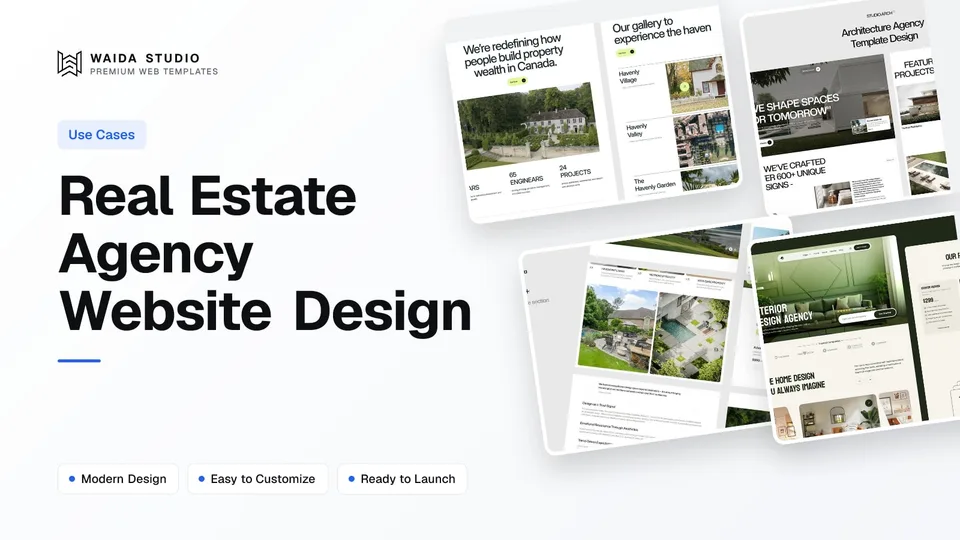
A real estate agency website has one job: turn a search for a neighbourhood into a conversation with an agent. That means fast listing pages, an agent roster with real contact details, and an enquiry or valuation form within reach of every page. Design decides how quickly a buyer finds those three things. Here is what to build, what the rules require, and what it costs.
What a Real Estate Agency Website Has to Do
Five jobs, in this order: show the listings, prove the agents are real people, capture an enquiry, answer the money questions, and load fast on a phone at the kerb. Everything else is decoration. The table below is the smallest site that does all five.
Page | What it does | What belongs on it |
|---|---|---|
Home | Sends a visitor to a listing or an agent | Search or featured listings, one clear enquiry action, the areas you cover |
Listings index | Lets people filter what you have | Price, beds, location, status, and a thumbnail that isn't badly cropped |
Listing detail | Sells one property | Gallery, map, floor plan, the agent handling it, an enquiry form |
Agents | Turns the agency into people | Photo, licence details, area covered, direct phone and email |
Sell or valuation | Captures the seller side | A short form, what happens next, a response time you can keep |
About and areas | Local proof | Neighbourhood pages, sold history, how the team works |
The valuation page is the one most agencies skip, and it is where seller enquiries come from. Keep its form to four fields and say when someone will call back. The same discipline applies to every other lead form on the site, as the guide to agency website design explains in more detail.
Listings: CMS, IDX Feed or Hand-Built Pages
Three routes, and the right one depends on how often your listings change. Hand-built pages suit an agency with a dozen live properties. A CMS collection suits one that updates weekly and wants full control of the layout. An IDX feed suits a brokerage that has to mirror the whole market.
Route | Best for | What it costs you |
|---|---|---|
Hand-built pages | Around a dozen live listings | Your time on every price change and every sale |
CMS collection | Weekly updates, full design control | A plan with the CMS on it: Framer Basic at $10 a month billed yearly, Webflow Premium at $25 a month billed yearly |
IDX feed from your MLS | Brokerages mirroring the full market | A feed agreement plus a developer or a vendor to integrate it |
On the platform side the numbers are public. Framer's pricing page lists a free plan with a Framer subdomain and 1 GB of bandwidth, Basic at $10 a month billed yearly with 2 CMS collections, and Pro at $30 a month with 10 collections, site redirects and a staging environment. Two collections is enough for listings plus agents.
Webflow's pricing page puts the CMS on its Premium plan at $25 a month billed yearly, with 20 collections and 20,000 CMS items. Basic, at $15 a month billed yearly, is described as being for sites that don't need a CMS, and the free Starter plan caps the CMS at 50 items. If your listings live in a collection, Premium is the plan you are buying.
An IDX feed is a different kind of project. The feed itself is built on the standards RESO publishes, the Web API and the Data Dictionary, and the terms for getting one come from the MLS you belong to — ask them before you budget the work, because the answer changes by market.
The Advertising Rules You Cannot Design Around
Two rules shape the copy and the markup, and both are content decisions rather than plugins. Federal fair housing law governs what a property advert may say, and the Justice Department expects the site to be usable by people with disabilities. Put both in the first draft, not in a compliance pass three months after launch.
- Fair housing. 42 U.S.C. § 3604(c) makes it unlawful to make, print or publish any notice, statement or advertisement about the sale or rental of a dwelling that indicates a preference, limitation or discrimination based on race, colour, religion, sex, handicap, familial status or national origin. That reaches headlines, neighbourhood write-ups and photo captions, not just the fine print.
- Accessibility. The Justice Department's web accessibility guidance says it has no regulation setting out detailed technical standards, and points to the Web Content Accessibility Guidelines as helpful guidance on how to make site features accessible. Practically: real alt text on listing photos, labelled form fields, and contrast you can read outdoors.
- Licence display. What a brokerage has to show about its licence and its agents is set by your state commission, so check their rules before the agents page is designed around a layout with no room for it.
Photography Is Your Performance Budget
Listing photography is why property sites are slow. Google's threshold for Largest Contentful Paint is 2.5 seconds, measured at the 75th percentile of loads, and a hero gallery of full-resolution camera files misses it on mobile data every time. Size every image to the slot it sits in.
- Export at roughly twice the displayed width, not at the camera's native size.
- Let the first gallery image load eagerly and the rest load as the visitor scrolls.
- Use one strong hero shot instead of a carousel that loads six.
- Load the map on interaction, not on page load.
- Check the result on a phone on mobile data, which is where buyers actually browse.
The 2.5-second threshold and the 75th percentile rule come from web.dev's Largest Contentful Paint documentation. If you want the rest of the technical checklist, the Framer SEO guide covers headings, metadata and image handling on a template-built site.
Structured Data for the Agency and Its Listings
Mark the agency up as a RealEstateAgent and each property page as a RealEstateListing. Both types exist already, so this is a copy-and-fill job rather than a design decision, and it is what lets a search engine tell an office apart from the properties it is selling.
Schema.org files RealEstateAgent under LocalBusiness, which inherits the address, telephone and opening-hours properties an office needs. RealEstateListing is a kind of WebPage — a listing that describes one or more real-estate offers — and adds datePosted and leaseLength on top of the usual page properties.
Google's local business structured data documentation requires only two properties, name and address, and asks you to use the most specific LocalBusiness subtype available, which for an agency is RealEstateAgent. Opening hours are recommended rather than required.
Four Waida Templates Built for Property Work
Our real estate category holds four templates, and we made all four, so treat this as our own shelf rather than a neutral review. Slateon covers rentals and listings, Studio Arch covers construction and development, Nuvora suits sustainable developers, and Zenvira is for interiors.
Slateon — rentals and listings

Slateon is the closest fit for an agency: listing layouts, property highlights and conversion-focused sections across 11 pages. It is free on Framer with a free Waida account — sign in, then remix it — and $79 on Webflow, $39 on HTML and $49 on Next.js or Astro. The Figma file is $19 and sold separately.
Studio Arch — construction and development

Studio Arch has 15 pages, with CMS-powered project entries on the Framer and Webflow versions, which makes it the better base for a developer or a design-and-build firm showing completed schemes rather than an index of live listings. It is $79 on Framer and Webflow, $39 on HTML and $49 on Next.js or Astro.
Check out Studio Arch template
Nuvora — sustainable developments

Nuvora is an 11-page template for sustainable architecture and real estate brands, built around project showcases and storytelling about how a development was made. Use it when the pitch is the building rather than the transaction.
Zenvira — interiors and staging

Zenvira has 14 pages aimed at interior designers and home decor brands, with room for large photography and material detail. For an agency it works best as a sister site for a staging or interiors arm, not as the main listings site.
What a Real Estate Agency Website Costs
Four routes, from a template you set up yourself to a custom build. The template prices below are ours; the hosting figures come from the two platform pricing pages linked earlier, and they are billed separately from anything you buy here.
Route | Price | What you get |
|---|---|---|
One template, set up yourself | $39–$79 | $79 on Framer or Webflow, $39 on HTML, $49 on Next.js or Astro; the Figma file is $19 extra |
Platform bundle | $99–$159 | Every template on one platform: $159 for Framer or Webflow, $99 for HTML, Next.js or Astro |
Pro plan | $12 a month billed yearly, or $299 once | Unlimited sections plus one template credit every quarter — see the plans in full |
$499 one-time | Seven-day delivery: logo, copy, colours, images, up to two custom sections, two rounds of revisions | |
Custom website | $5,000 one-time | Full build with a custom design system, CMS structure and the Figma design included |
Hosting | $10–$30 a month on Framer, $15–$25 on Webflow | Billed by the platform, not by us; on Webflow the CMS only arrives on the higher plan |
Every template carries the same licence: one person, unlimited projects, including commercial and client work, with no credit or attribution required. Ultra adds a team licence for three seats. The licence terms spell out what that covers before you put a client's brand on it.
Templates to start from
All 40 templates



Frequently asked questions
How much does a real estate agency website cost?
A template is $39 to $79 depending on the platform, and our customisation package is $499 with seven-day delivery. A full custom build is $5,000. Hosting is separate: from $10 a month on Framer and $15 a month on Webflow, both billed yearly.
Can I show MLS listings on my own website?
That needs an IDX feed from the MLS you belong to, and the terms for getting one come from that MLS. A template gives you the design; the feed and its integration are a separate piece of work with a developer or a vendor.
Is Framer or Webflow better for property listings?
Framer's Basic plan includes two CMS collections at $10 a month billed yearly, which covers listings and agents. Webflow puts its CMS on Premium at $25 a month billed yearly, with 20,000 items. Framer is cheaper for a small agency; Webflow scales further.
What do fair housing rules mean for my website copy?
Federal law bars adverts about the sale or rental of a dwelling that indicate a preference based on race, colour, religion, sex, handicap, familial status or national origin. That covers headlines, neighbourhood descriptions and photo captions, not only the legal footer.
Can I get a real estate template for free?
Slateon is free on Framer with a free Waida account: sign in, then remix it. On Webflow it is $79, and on HTML, Next.js or Astro it is $39 to $49. The Figma file is $19 and sold separately.
How many pages does a real estate agency site need?
Six page types cover it: home, listings index, listing detail, agents, a sell or valuation page, and about. Slateon ships with 11 pages and Studio Arch with 15, which leaves room for neighbourhood pages.
Build the six pages, decide the listings route before you choose a plan, and write the copy with fair housing in mind from the first draft. Most agencies do not need a custom build to do that — they need a template that already has listing layouts and an agents page, then a week of real photography and real copy.
If you want to start from something finished, the four real estate website templates in our catalogue are $79 on Framer and Webflow, $39 on HTML and $49 on Next.js or Astro, and Slateon is free on Framer with a free account.

More from Kazi
Related articles
More in Use Cases
Developer Portfolio Website: What to Include in 2026
What a developer portfolio website needs in 2026: the pages, project write-ups, GitHub, free hosting and a code template to start from.

Law Firm Website Design: What It Needs in 2026
What a law firm website needs in 2026: practice-area pages, attorney bios, a working intake path, and the advertising rules that govern every word on it.

Best Free Portfolio Website Templates: 10 Picks for 2026
Ten free portfolio website templates for designers, photographers, filmmakers and developers, with the platform costs and licence limits spelled out.