Plumbing Website Design: What Wins Plumbing and HVAC Calls in 2026
What a plumbing or HVAC website needs in 2026: a phone number that works in an emergency, one page per job type, licences customers can check and a page for every area you serve.
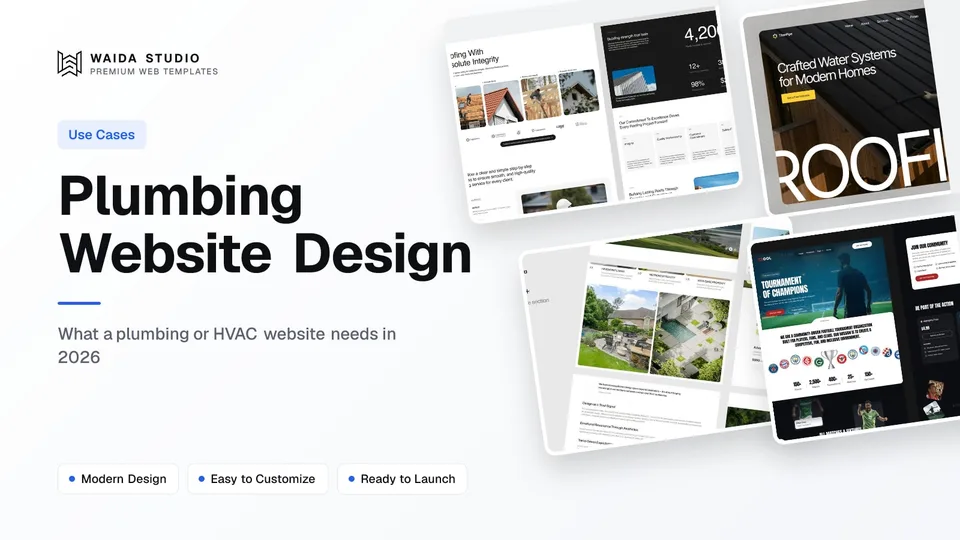
Good plumbing website design turns a stressed visitor with a leaking pipe or a dead boiler into a phone call within seconds. It puts a tap-to-call number at the top of every page, says plainly whether you take emergency calls, lists the jobs you do, and proves you are licensed in the area the visitor lives in.
This guide covers plumbing and HVAC companies together, because their customers behave the same way: urgent repairs by phone, planned installs by quote. It walks through the pages you need, the emergency path, trust signals, local search, speed, and what a template-built site costs. For the general version that suits any local firm, read how to make a small business website.
Two Kinds of Visitor, Two Paths
A plumbing or HVAC site serves two visitors at once, and the design has to separate them in the first screen. One has a burst pipe, a blocked drain or no heat and wants someone today; the other is planning a water heater replacement or a new air conditioning system and wants a price and a date.
Visitor | What they need to see | The action to offer |
|---|---|---|
Emergency repair | Do you come out now, tonight or at the weekend, and to my area? | A large tap-to-call button and your hours, including any call-out terms |
Planned repair | Can you fix this kind of problem, and when is your next slot? | Online booking or a short request form |
Replacement or install | What does a new water heater, furnace or AC unit roughly cost, and is financing available? | A quote request, ideally with a home visit |
Maintenance | Do you service boilers, furnaces and AC units every year? | A maintenance plan sign-up or a booking link |
Keep the emergency path one tap long. Put the phone number in the header as a real tap-to-call link, keep it visible as the visitor scrolls on mobile, and only say "24/7" if someone genuinely answers at 3 a.m.
The Pages a Plumbing or HVAC Website Needs
Most plumbing and HVAC companies need seven to nine page types. Job pages and area pages bring in search traffic, because people search for the problem in their town; the licence, reviews and pricing details do the persuading. Every page should end with the same two actions: call now or book.
Page | What goes on it | Why it matters |
|---|---|---|
Home | Phone number, emergency hours, the areas you cover, the main job types | Answers "can you help me, here, now?" in one screen |
One page per job type | Drain cleaning, leak repair, water heaters, furnace repair, AC installation, and so on | Each search like "water heater replacement" gets its own landing page |
Emergency service | What counts as an emergency, your hours, and how call-out charges work | Sets expectations before the phone rings |
Maintenance plans | What an annual visit includes, how often, and the price | Turns one-off jobs into repeat customers |
Financing | Which lender you work with and how to apply, if you offer it | Large installs often depend on it |
Service areas (one per town) | The jobs you do there and how quickly you usually arrive | Matches "plumber near me" searches |
About and licences | Your team, licence numbers, certifications and insurance | People let in tradespeople they can check |
Reviews | Real customer reviews, with a link to your Google profile | Backs up everything else on the site |
Contact and booking | Phone, form, booking link and what happens next | The page every other page points to |
A one-van business serving a single town can fold most of this into one long page. Our guide to services landing page design covers that format section by section, and the construction website design guide suits firms that also do remodelling and new builds.
Booking, Quotes and Maintenance Plans
Use the phone for emergencies, online booking for routine repairs and servicing, and a quote form for replacements and installs. You don't need to build any of it yourself; field service software handles the calendar and your website hosts the form.
- Online booking. Field service tools such as Housecall Pro say you can add their online booking form to your website, and they offer to embed it on the site for you. Put it on a dedicated Book page with a fixed height so the page doesn't jump while it loads.
- Quote requests should stay short: name, phone, postcode, the job, and a photo upload if your form supports it. A photo of a leaking valve or an old unit's label saves a wasted visit.
- Maintenance plans deserve their own page with what the annual visit covers and the price. Seasonal reminders for furnace checks in autumn and AC checks in spring give past customers a reason to come back.
- Financing, if you offer it, belongs on the replacement and install pages, not only in the footer. Name the lender and link to the application rather than quoting rates that may change.
- What happens next after any form: when you will call back, and whether a technician's arrival window comes by text.
Licences, Certifications and Reviews
A plumbing or HVAC customer is letting a stranger into their home to work on gas, water or electrics, so show proof they can check rather than adjectives. List licence numbers for each state or city you work in, and link to the official lookup where one exists.
- State licences. Many states run an online licence check. In California, for example, the Contractors State License Board links to a licence lookup for consumers, so a licence number on your site can be verified in a minute.
- Refrigerant certification for HVAC. The EPA requires Section 608 certification for technicians who maintain, service, repair or dispose of equipment that could release refrigerants. Saying your technicians hold it, if they do, answers a question informed customers ask.
- Insurance. State what cover you carry only if you hold it, and offer the certificate on request.
- Real team and van photos of your own technicians, not stock images of a model holding a wrench.
- A written guarantee on workmanship, with the period it covers.
Reviews need care. In the US, the FTC's Consumer Reviews and Testimonials Rule took effect on October 21, 2024. It bans fake reviews, rewards that depend on a review being positive, undisclosed reviews from staff or relatives, and threats used to get a bad review removed. Quote real customers with their permission and link to your Google reviews.
Local Search and Your Google Profile
Nearly every plumbing and HVAC job starts with a local search, so build one page per town you genuinely serve and set up your Google Business Profile to match. Google lets a service-area business list up to 20 service areas, and says the outer edge shouldn't be more than about two hours' drive from your base.
- Keep one name, phone number and service area list across your website, Google profile and directory listings.
- Write each area page for that area: the jobs you do most there, typical response times, and local details such as older housing stock or hard water. A page that only swaps the town name helps no one.
- Give each job page its own title, such as "Water Heater Replacement in Tulsa | Your Company".
- If customers never visit your premises, Google's advice is to remove the address from your profile and show the service area instead.
- Consider Google Local Services Ads. In the US, plumbers and HVAC (heating or air conditioning) are both listed as eligible categories, so the ads can send calls straight to your business.
Speed and Mobile Targets
Emergency visitors are on a phone, often outdoors or in a flooded utility room, so a plumbing site has to load fast on mobile data. Google's Core Web Vitals guidance sets the targets: the largest element on screen within 2.5 seconds, interactions answered within 200 milliseconds, and a layout shift score of 0.1 or less, measured at the 75th percentile of page loads.
Metric | Good threshold | What usually breaks it on a plumbing or HVAC site |
|---|---|---|
Largest Contentful Paint (LCP) | 2.5 seconds or less | A full-width hero photo of a van uploaded straight from a phone |
Interaction to Next Paint (INP) | 200 milliseconds or less | A chat widget, booking form and review carousel all loading at once |
Cumulative Layout Shift (CLS) | 0.1 or less | A promotion banner or booking embed that pushes the call button down after load |
Compress photos before uploading, keep one chat or callback tool rather than three, and make sure nothing loads above the phone number after the page appears. On Framer or Webflow, hosting is included in the plan, so there is no server to look after.
Plumbing and HVAC Website Templates to Start From
Waida Studio doesn't have a template made only for plumbers, so these two are the closest honest fits: both are built for home service and trade businesses, and one names HVAC and plumbing services in its "best for" list. They are our own templates, so weigh that; each is listed with its real price.
Steelcrest — for HVAC and plumbing firms that quote

Steelcrest is a roofing and construction template whose "best for" list includes HVAC and plumbing services. It has service pages, a projects gallery with before-and-after layouts, service-area pages for local search, an about page with room for certifications, and contact and quote request pages. It costs $79 on Framer or Webflow, $39 as HTML, and $49 for Next.js or Astro.
TitanPipe — free on Framer

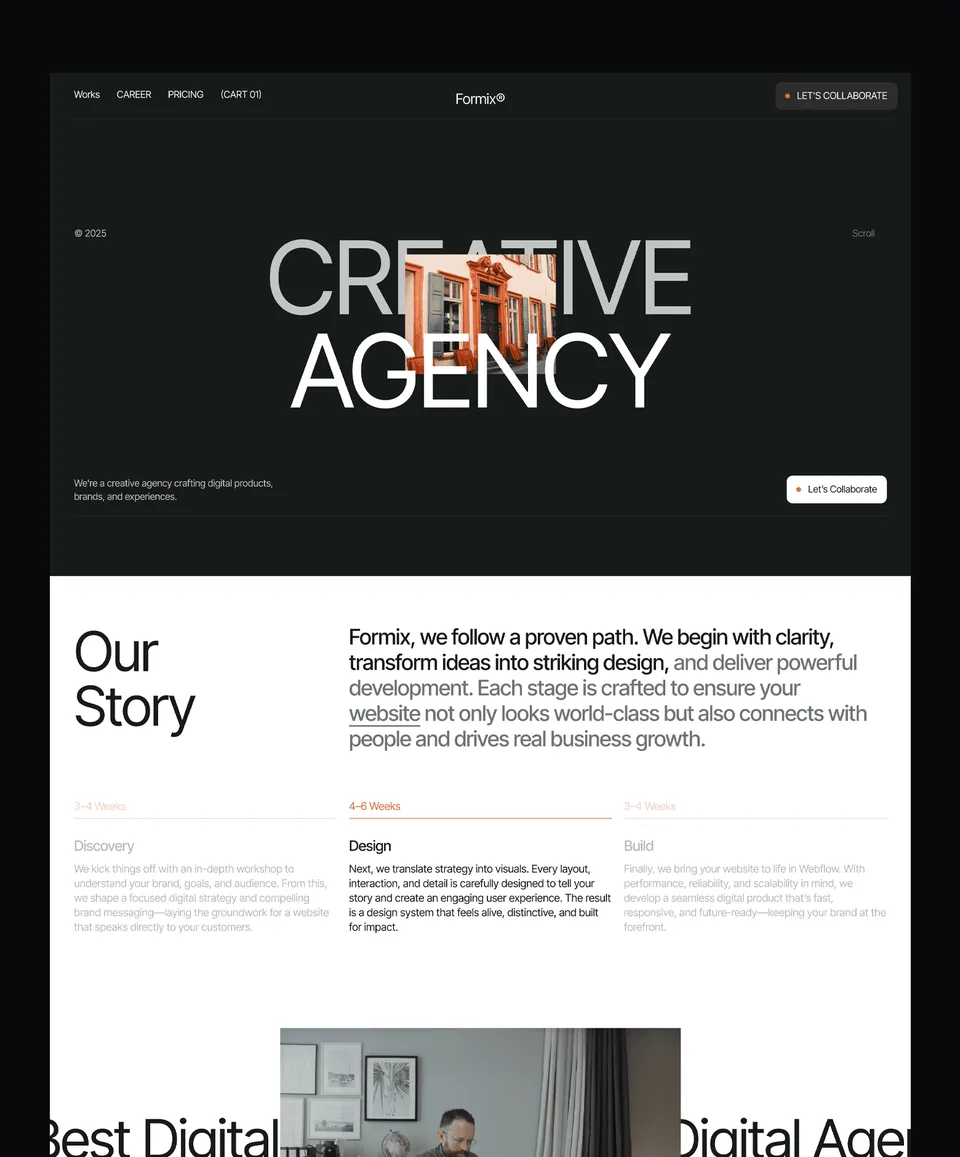
TitanPipe was designed for roofing companies and home service professionals, and its "ideal for" list includes home repair services and property maintenance providers. Its 11 pages include dedicated service and project pages with conversion-focused calls to action, which map onto job types and completed installs. It is free on Framer with a free Waida account, and $79 on Webflow, $39 as HTML, and $49 for Next.js or Astro.
Both sit in the business website templates category, alongside others that adapt well to trades. The Figma file for each is sold separately for $19.
What a Plumbing Website Costs
A template-built plumbing or HVAC website costs between nothing and $79 to launch, plus a platform plan from about $10 to $25 a month and whatever field service software you already use. Prices below were checked on each provider's own page on November 2, 2026.
Item | Price | Notes |
|---|---|---|
TitanPipe on Framer | Free | With a free Waida account |
Steelcrest on Framer or Webflow | $79 one-off | Or unlocked with a Waida Pro or Ultra plan credit |
Framer Basic plan | $10 a month | Custom domain, 2 CMS collections (framer.com/pricing) |
Webflow Basic / Premium | $15 / $25 a month, billed yearly | Basic has no CMS; Premium adds it (webflow.com/pricing) |
Waida template customisation | $499 one-off | Logo, copy, colours, images, up to 2 custom sections, 7-day delivery |
Waida custom website | $5,000 one-off | Full custom build; timeline varies |
Framer's free plan only publishes to a Framer domain and is described as ideal for non-commercial use, so a plumbing business should budget for a paid plan. For a fuller breakdown, see how much a website costs, and if you would rather hand the setup over, our customisation service does it for $499.
Templates to start from
All 44 templates



Frequently asked questions
What should a plumbing website include?
A tap-to-call phone number on every page, your emergency hours, one page per job type, a page per town you serve, licence numbers and insurance details, real customer reviews, and a booking or quote form.
Should a plumbing website show prices?
Show call-out terms and starting prices for common jobs if your pricing is predictable. Replacements and installs such as water heaters or AC units usually need a quote after a visit, so say that plainly.
Can customers book a plumber directly on my website?
Yes. Field service software such as Housecall Pro provides an online booking form you can add to your website, and Framer and Webflow sites can embed forms like that on a dedicated Book page.
Can plumbers and HVAC companies use Google Local Services Ads?
Yes. In the US, plumbers and HVAC (heating or air conditioning) businesses are listed as eligible categories for Google Local Services Ads, though availability depends on your area.
How much does a plumbing website cost?
Built from a template, a plumbing website costs from nothing to about $79 for the template, plus a platform plan from about $10 to $25 a month. A done-for-you customisation from Waida Studio costs $499.
Is there a free plumbing website template?
Waida Studio has no plumbing-only template, but TitanPipe, a home services template, is free on Framer with a free Waida account. Steelcrest, which lists HVAC and plumbing services among its uses, costs $79.
A plumbing or HVAC website that wins calls is simple: a tap-to-call number on every screen, honest emergency hours, one page per job and per town, licence numbers customers can check, and real reviews. Get those right before you spend time on animation or extra pages.
Start from TitanPipe, free on Framer with a Waida account, or Steelcrest at $79, and browse the rest of the professional services templates. Every Waida licence covers unlimited projects, including client work, under our licence terms.

More from Kazi
Related articles
More in Use Cases
Cleaning Website Design: What Books Cleaning Jobs in 2026
What a cleaning company website needs in 2026: a fast quote or booking path, a clear list of what each clean includes, checkable trust signals and a page per area you serve.

Event Website Design: What an Event Site Needs in 2026
A practical guide to event website design: the pages, agenda, ticketing hand-off, pricing and accessibility rules and search setup an event site needs.

Hotel Website Design: What a Hotel Site Needs in 2026
A practical guide to hotel website design: the pages, room details, booking engine, pricing and accessibility rules a hotel site has to get right.